간경변증에서의 비만 관리: 위험과 이득 사이의 균형

Management of Obesity in Liver Cirrhosis: A Delicate Balance of Risks and Benefits

Article information

Korean J Med. 2026;101(5):226-232
Publication date (electronic) : 2026 October 1
doi : https://doi.org/10.3904/kjm.2026.101.5.226
Division of Gastroenterology and Hepatology, Department of Internal Medicine, Gachon University Gil Medical Center, Gachon University College of Medicine, Incheon, Korea
신승각, 권오상
가천대학교 의과대학 가천대 길병원 소화기내과
Correspondence to: Oh Sang Kwon, M.D., Ph.D. Division of Gastroenterology and Hepatology, Department of Internal Medicine, Gachon University Gil Medical Center, Gachon University College of Medicine, 21 Namdong-daero 774beon-gil, Namdong-gu, Incheon 21565, Korea Tel: +82-32-460-3778, Fax: +82-32-460-3408, E-mail: kos@gilhospital.com
Received 2026 March 10; Revised 2026 May 24; Accepted 2026 July 6.

Trans Abstract

Metabolic dysfunction-associated steatotic liver disease (MASLD) has emerged as a major global cause of chronic liver disease and is closely associated with obesity and metabolic syndrome. Obesity contributes to MASLD progression and increases the risk of liver fibrosis, cirrhosis, and hepatocellular carcinoma. However, the management of obesity in patients with cirrhosis is complex, as the catabolic state characteristic of cirrhosis predisposes patients to sarcopenia, malnutrition, and frailty. Excessive weight reduction may therefore worsen muscle loss and adversely affect clinical outcomes. Accordingly, obesity management in cirrhosis should prioritize not only weight reduction but also optimizing body composition by preserving muscle mass and physical function. A comprehensive assessment of nutritional status, sarcopenia, and frailty is essential before initiating weight management strategies. Lifestyle interventions are the cornerstone of therapy and include individualized nutritional support and exercise programs. Moderate caloric restriction with adequate protein intake is recommended for patients with compensated cirrhosis, whereas maintenance of nutritional status is prioritized in those with sarcopenia or decompensated cirrhosis. Pharmacological therapies, such as glucagon-like peptide-1 receptor agonists, demonstrate potential benefits in MASLD; however, evidence in established cirrhosis remains limited. Bariatric surgery should be considered in carefully selected patients with compensated cirrhosis. Overall, obesity management in MASLD-related cirrhosis requires an individualized, multidisciplinary approach.

서 론

과도한 음주 없이 간 내 지방 축적이 발생하는 질환은 과거 비알코올지방간질환(non-alcoholic fatty liver disease, NAFLD)으로 명명되었으나 최근 비만, 인슐린 저항성, 당뇨병, 고혈압, 이상지질혈증 등 대사 이상과의 밀접한 연관성을 반영하여 대사이상지방간질환(metabolic dysfunction-associated steatotic liver disease, MASLD)이라는 용어로 개념이 개정되었다[1]. MASLD는 간경변증 및 간세포암의 중요한 원인으로 국내 MASLD의 유병률은 연구 대상, 정의, 진단 방법에 따라 약 25-33%로 다양하게 보고되고 있으며[2-4] 그 유병률이 지속적으로 증가하고 있다. 또한 서구에서는 최근 주요 간 이식의 원인 중 하나로 자리 잡고 있다[5,6]. 최근 메타분석에 의하면 MASLD 환자의 3.26%가 간경변증으로 확인되었고 이 중 69.8%가 비만을 동반하였다[7].

비만은 단순한 체중 증가가 아니라 인슐린 저항성, 만성 염증, 내장 지방 축적을 특징으로 하는 복합적인 대사 상태이다. 이러한 변화는 간섬유화의 진행 및 간질환 관련 합병증 발생 위험 증가와 연관되는 것으로 알려져 있다[8,9]. 또한 비만은 심혈관질환 위험 증가와 밀접하게 관련되어 있다[10]. 따라서 비만이 동반된 간경변증 환자에서는 적절한 체중 관리가 중요하다. 그러나 간경변증은 본질적으로 이화(catabolic) 상태를 특징으로 하며 단백질 분해 증가로 인해 근감소증이 동반되는 경우 환자의 예후가 불량한 것으로 보고되어 있다[11,12].

따라서 간경변증 환자에서의 비만 관리는 단순한 체중 감소가 아니라 체지방 감소와 함께 근육량과 기능을 유지하는 균형 잡힌 접근이 필요하다[13,14]. 본 종설에서는 비만을 동반한 간경변증 환자, 특히 MASLD 관련 간경변증(MASLD-related cirrhosis) 환자에서 안전하고 효과적인 비만 관리를 위한 임상적 고려사항을 제시하고자 한다.

본 론

간경변증 환자에서 비만 또는 근감소증의 상관관계

만성 간질환 환자에서 비만이 동반되는 경우 지방 조직 내 대식세포 침윤이 증가하고 tumor necrosis factor-alpha, interleukin-6와 같은 염증성 사이토카인의 분비가 증가한다. 이러한 염증 반응은 간성상세포(hepatic stellate cell)의 활성화를 촉진하여 간섬유화의 진행에 기여하는 것으로 보고되었다[15,16]. 또한 내장지방(visceral adiposity)은 인슐린 저항성과 지질 독성(lipotoxicity)을 유발하여 MASLD의 발생과 진행에 중요한 역할을 한다[17].

반면 간경변증 환자에서는 단백질 섭취 감소, 장 흡수장애, 근육 합성 감소 및 근육 분해 증가 등으로 인해 근감소증(sarcopenia) 의 발생 빈도가 높다[18]. 비만과 관련된 아디포넥틴(adiponectin)의 감소는 근육 조직에서 만성 염증을 유발할 수 있으며 비만에서 흔히 관찰되는 렙틴(leptin) 저항성 역시 인슐린 저항성 등 다양한 기전을 통해 근감소증의 발생과 연관되는 것으로 보고되었다[19].

특히 간경변증 환자에서 골격근은 암모니아 해독(ammonia detoxification)에 중요한 역할을 하므로 근감소증이 동반된 경우 간성 뇌증의 발생 위험이 증가한다. 또한 근감소증은 간경변증 환자에서 독립적인 사망 예후 인자로 보고되고 있다[12]. 따라서 근감소증이 동반된 간경변증 또는 비대상성 간경변증 환자에서 부적절한 체중 감량이나 비만 관리는 영양 상태를 악화시키고 근감소증을 심화시켜 환자의 임상적 예후에 부정적인 영향을 미칠 수 있다.

즉 간경변증 환자에서 비만 관리 전략을 수립할 때에는 체중 감량의 잠재적 이득과 위험을 균형 있게 고려해야 하며 간질환의 중증도뿐 아니라 영양 상태, 근감소증 여부, 노쇠(frailty)에 대한 종합적인 평가가 필요하다.

간경변증 환자에서 비만 관리 전 평가

간경변증 환자의 영양 상태를 평가하기 위한 도구로는 주관적 전반적 평가(subjective global assessment)와 Royal Free Hospital-Nutritional Prioritizing Tool (RFH-NPT) 등이 제시되고 있다. 특히 RFH-NPT는 간경변증 환자에서 영양 위험도를 체계적으로 평가할 수 있는 도구로 영양 상태에 따른 임상적 예후를 예측하는 데 유용한 것으로 보고되었다[20,21].

근감소증의 평가는 영상학적 또는 체성분 분석을 통한 골격근량의 정량적 측정과 함께 근력 및 신체 기능 평가를 포함하여 이루어진다. 골격근량 평가는 주로 전산화단층촬영(computed tomography) 기반의 근육량 분석 등 영상학적 방법을 이용하여 수행되며, 근력 평가는 악력(handgrip strength)이나 의자 일어서기 검사(chair stand test)를 통해 측정할 수 있다(Fig. 1). 또한 보행 속도(gait speed) 또는 간단 신체수행능력 검사(short physical performance battery)를 이용한 신체기능 평가 역시 근감소증 평가 방법으로 제시되고 있다[22-24].
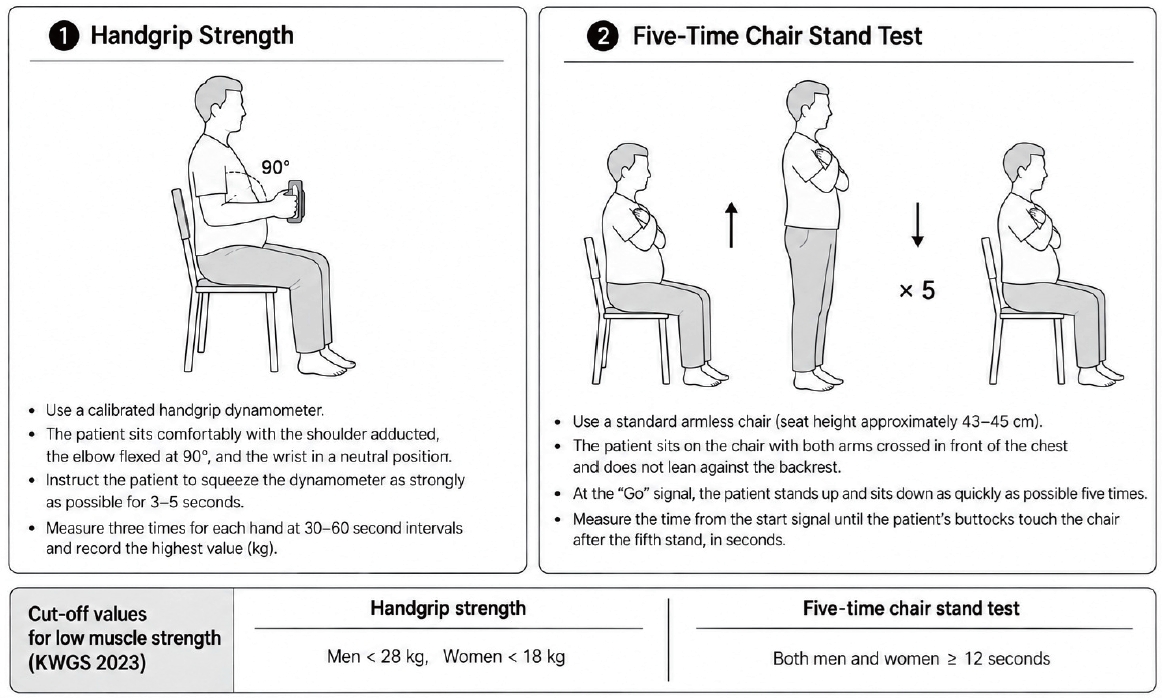
Figure 1.

Muscle strength assessment methods for diagnosing sarcopenia: handgrip strength and chair stand test. KWGS, Korean Working Group on Sarcopenia.

간경변증 환자에서 노쇠는 만성 간질환으로 인한 생리학적 예비 능력(physiological reserve)의 감소와 스트레스에 대한 저항성 감소로 인해 신체적 및 기능적 저하가 발생한 상태를 의미하며, 이는 합병증 발생과 사망 위험 증가와 밀접하게 연관되어 있다. 최근 간경변증 환자의 예후 평가에서 노쇠의 중요성이 점차 강조되고 있으며 간 노쇠 지표(liver frailty index, LFI)는 악력, 의자 일어서기(chair stands), 균형 검사(balance test)로 구성된 객관적 평가 도구로 간 이식 대기 환자의 사망 위험을 예측하는 지표로 활용되고 있다[25,26]. LFI 계산은 Liver Frailty Index Calculator (http://liverfrailtyindex.ucsf.edu)에서 확인할 수 있으며, 성별에 따라 보정된 악력(gender-adjusted grip strength), 초당 의자 일어서기 횟수(number of chair stands per second), 균형 유지 시간(balance time)을 이용하여 다음과 같은 공식으로 산출할 수 있다: LFI = (-0.330 × gender-adjusted grip strength) + (-2.529 × number of chair stands per second) + (-0.040 × balance time) + 6 [27].

이러한 영양 상태, 근감소증 및 노쇠 평가 도구들은 비만을 동반한 간경변증 환자에서 체중 감량 여부와 치료 전략을 결정하는 데 중요한 임상적 정보를 제공한다.

간질환 중증도에 따른 개별화된 영양 관리

간경변증 환자에서 생활습관 개선을 통한 비만 관리 전략을 수립할 때에는 간질환의 중증도와 영양 상태를 고려한 개별화된 접근이 권고된다. 대상성 간경변증 환자에서는 하루 약 500-800 kcal 정도의 적절한 칼로리 제한(moderate caloric restriction)과 함께 충분한 단백질 섭취(약 1.2-1.5 g/kg/day) 및 규칙적인 운동 요법이 권장된다[28]. 그러나 근감소증이 동반된 경우 또는 비대상성 간경변증 환자에서는 단순한 체중 감량보다는 영양 상태 유지와 근육량 보존이 더욱 중요하다. 특히 비만과 근감소증이 동시에 존재하는 근감소성 비만(sarcopenic obesity)은 MASLD 관련 간경변증 환자에서 흔히 관찰되는데, 단순 체질량지수만으로는 영양 상태를 적절히 반영하지 못하고 근감소증 정도가 환자의 예후, 신체기능 저하 및 사망률 증가와 연관되는 것으로 보고되고 있다[29,30]. 이러한 환자에서 비만 조절을 위한 과도한 열량 제한은 체지방과 함께 근육의 손실을 가속화하여 체중 감량의 건강상 이득과 근감소증 악화라는 위험이 공존하는 임상적 딜레마가 발생한다. 따라서 지방량 감소와 근육량 보존을 동시에 고려한 접근이 필요하며 충분한 단백질 섭취와 저항 운동(resistance exercise)을 병행하는 것이 중요하다[28,31].

한편 간경변증 환자에서는 장시간 공복 상태가 야간 단백질 분해와 근육 소실을 촉진할 수 있기 때문에 late-evening snack (LES)과 같은 추가적인 영양 공급이 권장된다[21,28,31]. LES는 야간 공복 시간을 단축시켜 에너지 대사를 개선하고 근육 소실을 감소시키는 데 도움이 되는 것으로 알려져 있다. 그러나 MASLD 관련 간경변증 환자에서는 LES가 총 열량 과다 섭취 및 체중 증가로 이어질 가능성이 있어 주의가 필요하다. 탄수화물 중심의 야식은 피하고 분지사슬아미노산(branched-chain amino acid) 기반 보충이나 단백질 중심의 LES가 보다 적절할 수 있다[32,33].

또한 과거에는 간성 뇌증 예방을 목적으로 단백질 섭취 제한이 권장되기도 하였으나 최근 연구에서는 이러한 접근이 근감소증과 영양실조를 악화시킬 수 있음이 보고되었다. 따라서 현재의 가이드라인에서는 특별한 상황을 제외하고 간경변증 환자에서 일상적인 단백질 제한을 권장하지 않는다[31,34].

운동 요법

운동은 간경변증 환자의 기능적 상태와 삶의 질을 개선하는 중요한 중재이다. 규칙적인 신체 활동은 인슐린 저항성을 개선하고 체지방 감소와 신체기능 향상에 도움이 될 수 있다[35]. MASLD 환자에서는 체중 감량을 위하여 주당 150분 이상의 중강도 운동이 권고되고 있으며 대상성 간경변증이 동반된 경우 주당 120-150분의 유산소 운동과 무리가 없다면 가벼운 저항 운동을 병행하는 것이 제시되고 있다[28,36,37]. 간경변증 환자를 대상으로 한 무작위 대조 시험에서는 운동의 6분 걷기 거리, 허벅지 둘레, 최대 산소 섭취량(VO2max) 증가를 포함한 신체기능 지표 개선 효과를 확인하였다[38].

한편 문맥고혈압이 동반된 환자에서 급성 고강도 운동은 일시적으로 간정맥압력차(hepatic venous pressure gradient, HVPG)를 증가시킬 수 있다는 소규모 연구가 보고된 바 있어 주의가 필요하다[39]. 그러나 이후 진행된 전향적 연구에서는 비만을 동반한 대상성 간경변증 환자에서 16주간의 식이 조절과 중등도 운동을 포함한 집중 생활습관 개선 프로그램이 비교적 안전하였고 체중과 HVPG를 감소시킬 수 있음을 보고하였다[40]. 메타분석에서도 대상성 간경변증 환자에서 운동 중재는 전반적으로 안전하며 신체기능, 삶의 질 등 관련 지표 개선에 도움이 될 수 있음이 제시되었다[41].

따라서 MASLD 관련 간경변증 환자에서는 환자의 임상 상태에 맞게 운동 강도와 방법이 조절되어야 한다. 특히 노쇠나 근감소증이 동반된 환자에서는 신체기능 평가를 기반으로 한 개별화된 운동 프로그램이 필요하며, 이를 통해 근육량과 신체기능의 유지 및 개선을 도모할 수 있다.

약물 치료와 외과적 접근법

최근 F2–3 단계의 간섬유화를 동반한 대사이상지방간염 환자를 대상으로 한 임상 3상 연구에서 glucagon-like peptide-1 receptor agonist (GLP-1 RA) 기전의 semaglutide 투여는 유의한 체중 감량과 함께 지방간염 및 간섬유화의 호전을 보여 관련 치료제로 승인받았다[42]. 그러나 대상성 간경변증 환자에서는 semaglutide 투여가 유의한 체중 감소는 확인되었으나 간섬유화 개선에서는 위약군과 비교하여 통계적으로 유의한 차이를 보이지 않았다[43]. 최근 대규모 코호트 연구에서는 간경변증이 동반되지 않은 MASLD 환자에서는 GLP-1 RA의 사용은 체중 감소와 대사 위험인자 개선뿐 아니라 간경변증 진행 및 사망 위험 감소와 관련이 있었으나 간경변증 환자에서는 이러한 보호 효과가 관찰되지 않았다(Table 1) [44]. 반면 GLP-1 RA는 식욕 감소와 오심, 구토 등의 위장관 부작용을 유발할 수 있어 일부 환자에서 영양 섭취 감소와 영양 불균형 및 근감소증을 악화시킬 가능성이 있다. 따라서 대상성 간경변증 환자에서 GLP-1 RA 약물을 사용할 경우 영양 상태 및 근감소증 악화 가능성을 고려하여 신중한 모니터링이 필요하다.
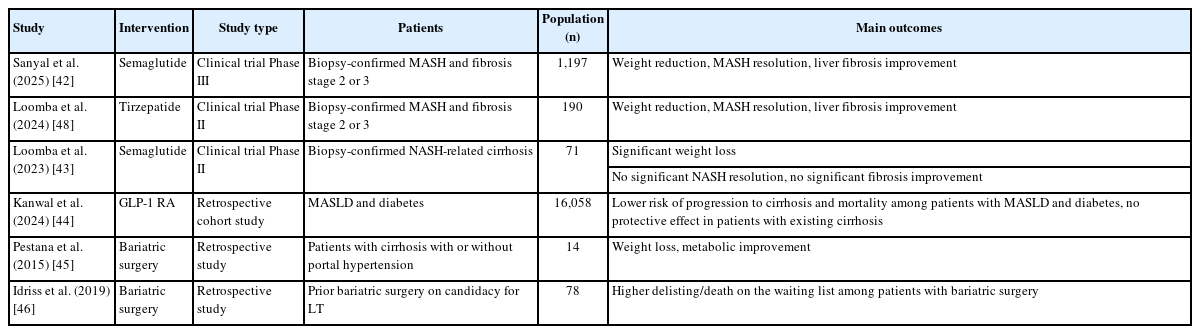
Summary of pharmacological and surgical treatments for MASLD-related fibrosis or cirrhosis

한편 비대상성 간경변증 환자에서는 GLP-1 RA 사용에 대한 근거가 제한적이며 안전성이 충분히 확립되지 않았다. 따라서 이러한 환자에서는 체중 감소 자체보다는 영양 상태 유지, 근감소증 예방 및 간 이식 평가가 우선적으로 고려되어야 한다.

비만을 동반한 대상성 간경변증에서의 비만 대사 수술(bariatric surgery)은 소규모 후향적 연구에서 체중 감소, 지방증 및 대사 개선 효과가 확인되었다[45]. 그러나 이전 비만 대사 수술 이력이 있는 간 이식 대상자를 대상으로 한 후향적 연구에서 비만 수술을 받은 환자들이 간 이식 대기자 명단에서 제외되거나 사망하는 비율이 더 높은 것이 확인되었다. 특히 영양 불균형과 근감소증을 동반한 환자에서 예후가 불량하였다(Table 1) [46]. 따라서 비만이 동반된 대상성 간경변증 환자에 대한 비만 대사 수술은 경험이 많은 기관에서 개별 환자의 간 기능, 영양 상태, 수술 위험도를 종합적으로 평가한 후 신중히 고려되어야 한다.

비대상성 간경변증 환자에서는 수술 관련 합병증 및 사망 위험이 증가할 수 있어 일반적으로 권고되지 않으며 간 이식과 동시에 또는 간 이식 후에 시행하는 비만 수술만이 고려될 수 있으나 이에 대해서도 아직 전문가 의견 수준으로 추가적 연구가 필요하다[47].

결 론

MASLD 관련 간경변증 환자에서 비만 관리는 단순한 체중 감소가 아니라 체성분의 최적화와 신체기능 보존을 목표로 해야 한다. 비만은 간질환의 진행을 촉진할 수 있으나 과도한 체중 감량은 영양 불균형을 초래하고 근감소증 및 노쇠를 악화시킬 수 있다. 따라서 임상에서는 간질환의 중증도뿐 아니라 영양 상태, 근감소증, 노쇠 동반 여부 등을 종합적으로 평가하여 개별화된 관리 전략을 수립하는 것이 중요하다.

향후 비만을 동반한 간경변증 환자에서 다양한 비만 치료 전략의 안전성과 효과를 평가하기 위한 추가 연구가 필요하다. 또한 영양 관리, 운동 요법, 약물 치료 등을 포함한 다학제적 접근(multidisciplinary approach)을 기반으로 한 통합적인 관리 전략의 확립이 요구된다.

Notes

CONFLICTS OF INTEREST

No potential conflict of interest relevant to this article was reported.

FUNDING

None.

AUTHOR CONTRIBUTIONS

SK Shin and OS Kwon conceived and designed the study. SK Shin participated in writing the article. OS Kwon participated in editing and proofreading. All authors have read and approved the final version of the manuscript.

ACKNOWLEDGEMENTS

None.

References

1. Sohn W, Lee YS, Kim SS, et al. KASL clinical practice guidelines for the management of metabolic dysfunction-associated steatotic liver disease 2025. Clin Mol Hepatol 2025;31 Suppl:S1–S31.
2. Oh JH, Ahn SB, Cho S, Nah EH, Yoon EL, Jun DW. Diagnostic performance of non-invasive tests in patients with MetALD in a health check-up cohort. J Hepatol 2024;81:772–780.
3. Park HJ, Lee S, Lee JS. Differences in the prevalence of NAFLD, MAFLD, and MASLD according to changes in the nomenclature in a health check-up using MRI-derived proton density fat fraction. Abdom Radiol (NY) 2024;49:3036–3044.
4. Lee CM, Yoon EL, Kim M, et al. Prevalence, distribution, and hepatic fibrosis burden of the different subtypes of steatotic liver disease in primary care settings. Hepatology 2024;79:1393–1400.
5. Ginès P, Serra-Burriel M, Kamath PS. Metabolic dysfunction-associated steatotic liver disease-the new epidemic of chronic liver disease. JAMA Netw Open 2025;8e2516381.
6. Younossi ZM, Stepanova M, Ong J, et al. Nonalcoholic steatohepatitis is the most rapidly increasing indication for liver transplantation in the United States. Clin Gastroenterol Hepatol 2021;19:580–589.e5.
7. Owrangi S, Paik JM, Golabi P, et al. Meta-analysis: global prevalence and mortality of cirrhosis in metabolic dysfunction-associated steatotic liver disease. Aliment Pharmacol Ther 2025;61:433–443.
8. Charlton MR, Burns JM, Pedersen RA, Watt KD, Heimbach JK, Dierkhising RA. Frequency and outcomes of liver transplantation for nonalcoholic steatohepatitis in the United States. Gastroenterology 2011;141:1249–1253.
9. Berzigotti A, Abraldes JG. Impact of obesity and insulin-resistance on cirrhosis and portal hypertension. Gastroenterol Hepatol 2013;36:527–533.
10. Hagström H, Tynelius P, Rasmussen F. High BMI in late adolescence predicts future severe liver disease and hepatocellular carcinoma: a national, population-based cohort study in 1.2 million men. Gut 2018;67:1536–1542.
11. Meyer F, Bannert K, Wiese M, et al. Molecular mechanism contributing to malnutrition and sarcopenia in patients with liver cirrhosis. Int J Mol Sci 2020;21:5357.
12. Tantai X, Liu Y, Yeo YH, et al. Effect of sarcopenia on survival in patients with cirrhosis: a meta-analysis. J Hepatol 2022;76:588–599.
13. Chen H, Yang C, Yan S, Liu X, Zhou L, Yuan X. Sarcopenia in cirrhosis: from pathophysiology to interventional therapy. Exp Gerontol 2024;196:112571.
14. Kumar N, Choudhary NS. Treating morbid obesity in cirrhosis: a quest of holy grail. World J Hepatol 2015;7:2819–2828.
15. Pezzino S, Puleo S, Luca T, Castorina M, Castorina S. Adipokine and hepatokines in metabolic dysfunction-associated steatotic liver disease (MASLD): current and developing trends. Biomedicines 2025;13:1854.
16. Marra F, Aleffi S, Bertolani C, Petrai I, Vizzutti F. Adipokines and liver fibrosis. Eur Rev Med Pharmacol Sci 2005;9:279–284.
17. Bansal SK, Bansal MB. Pathogenesis of MASLD and MASH - role of insulin resistance and lipotoxicity. Aliment Pharmacol Ther 2024;59 Suppl 1:S10–S22.
18. Dasarathy S, Merli M. Sarcopenia from mechanism to diagnosis and treatment in liver disease. J Hepatol 2016;65:1232–1244.
19. Iwaki M, Kobayashi T, Nogami A, Saito S, Nakajima A, Yoneda M. Impact of sarcopenia on non-alcoholic fatty liver disease. Nutrients 2023;15:891.
20. Borhofen SM, Gerner C, Lehmann J, et al. The Royal Free Hospital-Nutritional Prioritizing Tool is an independent predictor of deterioration of liver function and survival in cirrhosis. Dig Dis Sci 2016;61:1735–1743.
21. European Association for the Study of the Liver. EASL clinical practice guidelines on nutrition in chronic liver disease. J Hepatol 2019;70:172–193.
22. Liu Y, Ji F, Nguyen MH. Sarcopenia in cirrhosis: epidemiology, diagnosis, management and prognosis. Curr Opin Gastroenterol 2023;39:131–139.
23. Behiry ME, Mogawer S, Yamany A, et al. Ability of the short physical performance battery frailty index to predict mortality and hospital readmission in patients with liver cirrhosis. Int J Hepatol 2019;2019:8092865.
24. Goh MJ, Kim J, Chang WH, et al. Pretransplant functional status predicts postoperative morbidity and mortality after liver transplantation in patients with cirrhosis. Gut Liver 2023;17:786–794.
25. D’Arcangelo F, Zanetto A, Ferrarese A, et al. Frailty and sarcopenia in patients with cirrhosis awaiting liver transplantation: evidence from a single-centre, prospective cohort study. Updates Surg 2024;76:1807–1818.
26. Lai JC, Feng S, Terrault NA, Lizaola B, Hayssen H, Covinsky K. Frailty predicts waitlist mortality in liver transplant candidates. Am J Transplant 2014;14:1870–1879.
27. van Jacobs AC. Frailty assessment in patients with liver cirrhosis. Clin Liver Dis (Hoboken) 2019;14:121–125.
28. European Association for the Study of the Liver, ; European Association for the Study of Diabetes, ; European Association for the Study of Obesity. EASL-EASD-EASO clinical practice guidelines on the management of metabolic dysfunction-associated steatotic liver disease (MASLD). J Hepatol 2024;81:492–542.
29. Montano-Loza AJ, Angulo P, Meza-Junco J, et al. Sarcopenic obesity and myosteatosis are associated with higher mortality in patients with cirrhosis. J Cachexia Sarcopenia Muscle 2016;7:126–135.
30. Nishikawa H, Nishiguchi S. Sarcopenia and sarcopenic obesity are prognostic factors for overall survival in patients with cirrhosis. Intern Med 2016;55:855–856.
31. Merli M. Nutrition in cirrhosis: dos and don’ts. J Hepatol 2020;73:1563–1565.
32. Maki H, Yamanaka-Okumura H, Katayama T, et al. Late evening snacks with branched-chain amino acids improve the Fischer ratio with patients liver cirrhosis at fasting in the next morning. Clin Nutr ESPEN 2019;30:138–144.
33. Okamoto M, Sakaida I, Tsuchiya M, Suzuki C, Okita K. Effect of a late evening snack on the blood glucose level and energy metabolism in patients with liver cirrhosis. Hepatol Res 2003;27:45–50.
34. Korean Association for the Study of the Liver. KASL clinical practice guidelines for liver cirrhosis: varices, hepatic encephalopathy, and related complications. Clin Mol Hepatol 2020;26:83–127.
35. Jan CF, Nfor ON, Huang JY, et al. Exercise might prevent cirrhosis in overweight and obese adults. Liver Int 2018;38:515–522.
36. Rinella ME, Neuschwander-Tetri BA, Siddiqui MS, et al. AASLD practice guidance on the clinical assessment and management of nonalcoholic fatty liver disease. Hepatology 2023;77:1797–1835.
37. Razzak IA, Fares A, Stine JG, Trivedi HD. The role of exercise in steatotic liver diseases: an updated perspective. Liver Int 2025;45:e16220.
38. Zenith L, Meena N, Ramadi A, et al. Eight weeks of exercise training increases aerobic capacity and muscle mass and reduces fatigue in patients with cirrhosis. Clin Gastroenterol Hepatol 2014;12:1920–1926.e2.
39. García-Pagàn JC, Santos C, Barberá JA, et al. Physical exercise increases portal pressure in patients with cirrhosis and portal hypertension. Gastroenterology 1996;111:1300–1306.
40. Berzigotti A, Albillos A, Villanueva C, et al. Effects of an intensive lifestyle intervention program on portal hypertension in patients with cirrhosis and obesity: the SportDiet study. Hepatology 2017;65:1293–1305.
41. Jamali T, Raasikh T, Bustamante G, et al. Outcomes of exercise interventions in patients with advanced liver disease: a systematic review of randomized clinical trials. Am J Gastroenterol 2022;117:1614–1620.
42. Sanyal AJ, Newsome PN, Kliers I, et al. Phase 3 trial of semaglutide in metabolic dysfunction-associated steatohepatitis. N Engl J Med 2025;392:2089–2099.
43. Loomba R, Abdelmalek MF, Armstrong MJ, et al. Semaglutide 2·4 mg once weekly in patients with non-alcoholic steatohepatitis-related cirrhosis: a randomised, placebo-controlled phase 2 trial. Lancet Gastroenterol Hepatol 2023;8:511–522.
44. Kanwal F, Kramer JR, Li L, et al. GLP-1 receptor agonists and risk for cirrhosis and related complications in patients with metabolic dysfunction-associated steatotic liver disease. JAMA Intern Med 2024;184:1314–1323.
45. Pestana L, Swain J, Dierkhising R, Kendrick ML, Kamath PS, Watt KD. Bariatric surgery in patients with cirrhosis with and without portal hypertension: a single-center experience. Mayo Clin Proc 2015;90:209–215.
46. Idriss R, Hasse J, Wu T, et al. Impact of prior bariatric surgery on perioperative liver transplant outcomes. Liver Transpl 2019;25:217–227.
47. Patton H, Heimbach J, McCullough A. AGA clinical practice update on bariatric surgery in cirrhosis: expert review. Clin Gastroenterol Hepatol 2021;19:436–445.
48. Loomba R, Hartman ML, Lawitz EJ, et al. Tirzepatide for metabolic dysfunction-associated steatohepatitis with liver fibrosis. N Engl J Med 2024;391:299–310.

Article information Continued

Figure 1.

Muscle strength assessment methods for diagnosing sarcopenia: handgrip strength and chair stand test. KWGS, Korean Working Group on Sarcopenia.

Table 1.

Summary of pharmacological and surgical treatments for MASLD-related fibrosis or cirrhosis

Study Intervention Study type Patients Population (n) Main outcomes
Sanyal et al. (2025) [42] Semaglutide Clinical trial Phase III Biopsy-confirmed MASH and fibrosis stage 2 or 3 1,197 Weight reduction, MASH resolution, liver fibrosis improvement
Loomba et al. (2024) [48] Tirzepatide Clinical trial Phase II Biopsy-confirmed MASH and fibrosis stage 2 or 3 190 Weight reduction, MASH resolution, liver fibrosis improvement
Loomba et al. (2023) [43] Semaglutide Clinical trial Phase II Biopsy-confirmed NASH-related cirrhosis 71 Significant weight loss
No significant NASH resolution, no significant fibrosis improvement
Kanwal et al. (2024) [44] GLP-1 RA Retrospective cohort study MASLD and diabetes 16,058 Lower risk of progression to cirrhosis and mortality among patients with MASLD and diabetes, no protective effect in patients with existing cirrhosis
Pestana et al. (2015) [45] Bariatric surgery Retrospective study Patients with cirrhosis with or without portal hypertension 14 Weight loss, metabolic improvement
Idriss et al. (2019) [46] Bariatric surgery Retrospective study Prior bariatric surgery on candidacy for LT 78 Higher delisting/death on the waiting list among patients with bariatric surgery

MASLD, metabolic dysfunction-associated steatotic liver disease; MASH, metabolic dysfunction-associated steatohepatitis; NASH, nonalcoholic steatohepatitis; GLP-1 RA, glucagon-like peptide-1 receptor agonist; LT, liver transplantation.